![Carte Blanche [Skateboarding]](https://storage.ghost.io/c/e8/66/e866238d-c304-4142-8930-e488e4890869/content/images/2026/08/Carte-Blanche---Skateboar-4.png)
How Skateboard Movies Defined and Delineated Skateboarding Culture Since 1965 (and how the future is forever altered)
(Part 1)
Every era, someone pointed a camera at a skateboarder, cut the footage into a shape, and smuggled the result into homes, contest halls, and shop TVs. The filmer and the director were usually the same person, so the image and the argument came from the same hands.
In that sense, skate movies were decision-impulse documentation. A trick list, fillers, hammers, ambiance, contests, a crime scene, or a joke… Everything passed through the sieve from Noel Black to William Strobeck. From an Éclair camera to a smartphone opening the gate to a platform.
The skate movies’ chronicle of events underscores a crucial observation: outsider directors, brand auteurs, shop crews, video magazines, solo‑part specialists, and finally the algorithm have each taken turns deciding what counts as “real” skateboarding and what gets left off the tape. What follows isn’t a recap of the classics; it’s a sixty‑year trail of these decisions—how they defined the culture and how that culture is now being rearranged faster than it can fully understand itself.
I. The first narrative
In the skateboard movie genre, Devil's Toy and Skater Dater are the genesis. Yet Skater Dater, Noel Black's 1965 short film, carries the most emotional charge. Shot in the South Bay of Los Angeles and awarded at the Cannes Film Festival the following year, Skater Dater was filmed in 35mm by Michael D. Murphy using an Éclair Camera, with a budget not exceeding $9000. Not only did it present skateboarding as an atypical novelty, but it also showcased the burgeoning skateboarding community alongside the “real” world.
The film is often remembered for its coming-of-age frame and its romance. It had no spoken dialogue. A boy skates with his friends. A girl appears and becomes interested. The solid oakwood skateboards become joust mounts before being put aside, then — as those things go — are eventually picked back up.
Beyond its embryonic form and youthful, classic California atmosphere, Skater Dater already suggests several timeless constants: skateboarding as a magnet for like-minded outsiders; an art inseparable from skill; competition, intrinsically present even when no contest is visible; and a body language with its own codes of unsociability, awkwardness, elegance, and status. Skateboarding is shown as an elaborate behavior of timeless sophistication and bravado, breathing in the simplicity and vivid accuracy of the lifestyle being created around it. It was the first time skateboarding was presented in such a poetic way.
II. Outsiders with budgets
By the mid-1970s, skateboarding had shed enough of its “surfing's little brother” identity to justify a feature-length runtime. Go For It was released in 1976 and is often cited as the first action-sports feature; Skateboard Kings, the British documentary, followed in 1978, and Skateboard Madness in 1980. These were theatrical releases, made for paying audiences, and the directors who made them were, for the most part, not skateboarders.
They were produced using a recipe already proven successful in Bruce Brown's On Any Sunday, Warren Miller's ski films, or The Endless Summer. Action threaded through lifestyle and personality, with a narrator supplying the arc.
Skateboarders, especially the Z-Boys, were the lifestyle equivalent of rock stars, so shooting a Skateboard Kings sequence of Tony Alva, Billy Yeron, and Paul Constantineau getting up, checking the waves, deciding to get breakfast, and hitting a backyard pool was like shooting Jimi Hendrix at the Scotch of St James. It doesn’t seem like much now, but it was a slice of life, turning an everyday moment into mythology. These films existed to show action, stoke the crowd, and make a profit and an impression (for a film director). They existed in an exaggerated limbo zone. Yet their segment-based construction and action-first logic contributed to the basic narrative architecture: build interest, escalate motion, move toward the payoff. In retrospect, they had all the characteristics of unassuming cultural prototypes. A decade earlier, the 1965 pioneer movie had left a usable frame that Freewheelin' (1976), Scott Dittrich's loose ode to a teenage Stacy Peralta, takes over. It’s less a film than a daydream with a camera: downhill runs, pool sessions, and a soft-focus romance à la Skater Dater with Camille Darrin. Its critique is also its charm — nothing is at stake except the afternoon — but watch Peralta glide through it, and you can already see the future director studying how a lifestyle photographs, taking notes he would cash in eight years later. A little nudge? There are a couple of clips of Freewheelin’ in Public Domain 12 years later. No good stone is left unturned.
III. Step in, step up
In 1982, as part of a trade show promotional effort, Stacy Peralta (flanked on the creative side by Craig R. Stecyk III and on the entrepreneurial side by George Powell) helped usher in the modern media era by creating Skateboarding in the 80s, an 8-minute promotional reel. The video starts with Steve Caballero and Mike McGill at the Marina Del Rey keyhole pool, continues with Rodney Mullen, and ends with Tony Hawk skating the Del Mar Skate Ranch keyhole pool. They were 17, 17, 16, and 14 years old, respectively. The crowd wouldn’t move from the Powell-Peralta booth. Barely (if even) commercialized, the tape existed in only a handful of copies, passed from hand to hand. It took weeks to reach Europe and the rest of the world. Geography may be an obstacle, but synchronization was starting to happen. The clock began to tick. Kids across the country—and then across the world—entered a tacit, cult-like communion. The “cult” feeling? Teenage skateboarders would feverishly go out of their way to duplicate an already worn-out second-hand VHS tape. In the US, Australia, and Europe, groups of skateboarders stormed newly opened burger joints, cassette in hand, and demanded that the manager play it in exchange for their business. Beyond these temporal anecdotes, a foundational pillar emerged that is nowhere to be seen now.
Stacy Peralta seized the moment. Not only was The Bones Brigade Video Show inevitable, but it was also the first complete attempt at what would become a marketing tool, a lifestyle document, and a piece of culture-making… all at once. The team is the editorial argument and the stem of documentation, wrapped in one intricate piece that delivers several layers at once. It was the first full-length skateboard video to experiment with framing skateboarding through recurring personalities, humor, atmosphere, pacing, and visual identity as much as through tricks themselves. The videos presented viewers with an inhabitable world. Their skits, performed with nonexistent acting skills, did something fundamental: they created a universal code connecting tricks to persona, persona to group identity, and group identity embraced by the viewers. They became instant inside jokes that kids around the globe perpetuated ad infinitum, building one of the most vibrant communities beyond borders. The best part is that it might not have been fully intentional, at least not with that specific outcome in mind. Once again, the response blew out all expectations. Around the world, demand grew exponentially. In an era when almost everything is available with a click, it is hard to grasp the mix of disbelief and excitement at having to duplicate 10,000 videotapes week after week. Powell-Peralta couldn't keep up with the demand, and somehow, waiting became part of the process. At this very moment, the tribe became self-aware on an unprecedented global scale. That inhabitable world came with a catch that only surfaces with time. Hand The Bones Brigade Video Show to a teenager who has never seen it, and much of it won’t land — the skits play as strange, the pace as slow, the tricks as modest. That isn’t the video failing, and it isn’t the kid; idioms are sealed to their era. Watching it now is a little like a hip-hop dancer watching Fred Astaire: the command is plain to see, but the stakes and the codes — why it mattered, what it broke from — stay locked in the moment that made it. This was true from the first tape onward. Each wave of skateboarding made full sense to the people inside it and blurred for everyone who came after.
Craig R Stecyk III has been crucial to delivering the coded message. He already had a rich history of doing so, having documented the Dogtown era. His conceptualization of the Powell universe through unhinged ad design, slogans, and propaganda material produced a kaleidoscopic explosion unlike anything experienced before. In photography, he is often almost anthropological, exploring street details and unforced social space. He co-directed Public Domain (1988) and Ban This (1989), further bringing his work into the foreground and fixing an untheorized reality into the visual canon before anyone ossified the narrative into something coherent. From this symbolic texture emerged cultural authorship. Kids everywhere were swimming in a sea of symbols and references, reaching far beyond mere practice. It’s hard to imagine how skateboarding would have evolved without that richness.
Santa Cruz's Wheels of Fire came out in 1987 and ran a different current through the same decade. It inherited more of the 70s action-sports approach, thanks to its director Scott Dittrich (the same one who made Freewheelin’). The skating carried it, and the non-skating material, laced with hardcore and punk, wrapped up the attitude the brand had already established with the original team of George Orton, Steve Olson, Steve Alba, and Duane Peters. It was not less produced than the Powell videos, but less staged and more ambient. Powell-Peralta was Hollywood. Santa Cruz was the flyer on a telephone pole, with an equally influential energy. Streets on Fire, the NHS's second video from 1989 (immediately followed by Speed Freaks), features its own type of action-based skits.
There’s a significant blind spot, though, in the form of Cara-Beth Burnside. She became the first woman to grace the cover of Thrasher in May 1989, entered men's contests because there was no women's division, and showed uncanny consistency and determination. Yet in the same year, her own sponsor released Streets on Fire and Speed Freaks, and she appears in neither in any meaningful way (or at all!). It’s a huge cultural miss that can only be explained by the absence of immediate ROI in the slower-moving feminine market of the late 80s. The videos simply made visible where the money was, which is precisely what made them impactful. The loop closed on its own: no footage, no proof; no proof, no lineage. Watching her contest footage from back then, you realize what a missed opportunity it truly was. It’s enraging. Meanwhile, Powell-Peralta had Sophie Bourgeois, Lori Rigsbee, and Anita Tessensohn in Public Domain. Unfortunately, they had shorter careers and were less legible advocates of feminine skateboarding. The videos were no longer recording who counted; they were deciding who counted. The next generation would take that editorial power out of the pool and into the street.
IV. Pivot grammar
Given the high-maintenance nature of private ramps, their relative scarcity, and the vast accessibility of street skating, skaters chose. That choice was closely tied to the merger of small companies like H-Street, World Industries, and Alien Workshop, and to their young talents invading the streets.
When Stacy Peralta and Craig Stecyk explored high-quality filmmaking for Public Domain in 1988, they used Super 8mm, 3/4-inch video, and 16mm film. They also built many unusual camera rigs to capture street scenes and vert segments, and they brought in a second camera angle and an editor. Most importantly, they were adults who came of age during the era that ushered in the transition from flat (or bank riding) to full-blown vertical, so they carried the multidisciplinary narrative with them. They anchored it in pre-planned scenarios, team aura, and stylized framing. The storytelling was a savant collage of cultural perspectives, juxtaposed with modern skateboarding, including that of young Mike Vallely (a year before he switched to World Industries and appeared in Rubbish Heap a year later, along with WI co-founder Rodney Mullen, at a time when leaving Powell-Peralta was unthinkable).
1988 was also the year Mike Ternasky released H-Street's Shackle Me Not. It was beautiful in its rawness and felt authentic. The skating did the talking. The team riders skated over snippets of conversation: no skits or acting. Skating was changing. It demanded mobility, proximity, flexibility, patience, and a different editorial mindset. Smaller cameras brought a new understanding of structure. Around the same time, Steve Rocco brought in Spike Jonze as World Industries' photographer. After a couple of photo shoots, he gave Spike the company credit card to buy a camera. Rubbish Heap is his first film.
Hokus Pokus (1989), A Soldier's Story (1991), and This Is Not... (1991) are videos in which skateboarding embraced a documentary approach while becoming more self-conscious. Mike Ternasky understood — earlier than most — that a skateboard video was a structure, not just a container. The part was a unit, and its place in the video's chronology already told a lot. Within the part, tricks modulated against each other in a grammar of trick selection, escalation order, interplay with music, the rhythm of attempts and makes, and the relation between rawness and polish — all of this became more deliberate. A line led to another; a trick changed the stakes of the next until the closing hammer (the term wasn’t used yet). As skate videos began to think editorially, the architecture revealed itself as both obvious and satisfying. Without a shadow of a doubt, his generation looked at The Search for Animal Chin and took its theatricality without adopting its ambition. They didn't have the budget or the desire to pursue that format. The same sealing ran the other way: to the street kids, the vert era was already a half-foreign country — visible, admired in parts, but not theirs to inhabit. And their own videos would one day look just as sealed to whoever came next.
Technical skating was progressing by the week, and the gear was small enough to meet the need for immediacy. Stepping into this type of street skating required a different kind of documentation — not a crew posted up at a ramp, but a kid with a VX1000 skating to a spot, filming a trick “never been done” (NBD in spot parlance). When the trick landed, a particular kind of editing became possible. When the trick didn't land, a particular kind of persistence — dedication to a spot, to a line, to a single trick — became the story. Questionable (1992) is the cornerstone of that shift, after which you could not go back.
Jacob Rosenberg, who came up through this generation, clearly stakes a claim. “Ternasky envisioned a theatricality to skate videos, and once the vert era is out and street skating is in, it all starts to change. The storytelling and the structure emerge from leading up to a finale, a big trick, or a payoff,” he said during an SDSU panel discussion on the very subject of this piece. Since Ternasky, for close to a decade, the plot was often discovered during the making: through the skaters' choices, the terrain, the footage gathered, and the music that unlocked the right emotional key. That is one reason why Questionable feels so central in hindsight. It focused on maturing the language of street skating on film — one in which filming, editing, music, and performance fuse into something that transcends documentation. This was the when; the hows and whys are more determinative. The Powell and Santa Cruz were made in “one take,” or at most a couple of takes. The skaters showed what they had, period. Ternasky's “flexibility,” mentioned earlier, meant a real effort to push the tricks further. Concretely, that meant as many tries as necessary, and more often, trying and pulling off the new trick on the spot. It changes the creative process at every stage of the project.
Meanwhile, Spike Jonze was already incorporating scripted narratives into his videos. Rubbish Heap presents the premise of this, mixed with a clear reality take à la Ternasky; Video Days (1991) points even more toward the Hollywood approach à la Peralta.
V. Mixing genres
By 1993, vert skateboarding was clinically dead. The October 1993 issue of Thrasher Magazine examines the cultural shift in skateboarding, its industry, and skate media. The reality was less dramatic than the tombstone on the cover. In this Thucydides Trap (Rocco as the up-and-coming “small guy”), the bigger companies had documented the rise of street skating since the mid-80s, without realizing it would lead to their downfall 10 years later.
The need for and consumption of footage became vital and skyrocketed, so 1993 isn't remembered for a death but for the proliferation of gritty street skating and the birth of 411 Video Magazine (1993 - 2005). 411 was international in essence, and its brand videos were international by deduction. The irony is that 411 started as a failed attempt to create a print magazine. It featured low‑intent, high‑consequence editing. Every magazine-like column was there: “Contests”, “Profiles”, and “Chaos.” In practice, it formalized a global grammar based on a radically different approach to time and composition. About 60 minutes of footage was released every two months.
Almost instantly, video magazines accelerated the point of contact, the proof of existence. It happened between releases. Waiting for new footage was no longer such a torture. What was torture was the endless, delicious anticipation of what would come next. Skateboarding progressed exponentially thanks to them. 411 would keep you on your toes, so to speak, and, by ricochet, it did wonders for local scenes, inspiring local crews and raw shop videos. 411 became the catalyst in the era of audiovisual transfiguration; it opened the door to On Video (summer 2000 to winter 2004), a higher-end production that dug into skate history (not too deep, though, just into the previous decade). At the same time, in Europe, Puzzle emerged as the VHS/DVD magazine in the late 1990s/early 2000s.
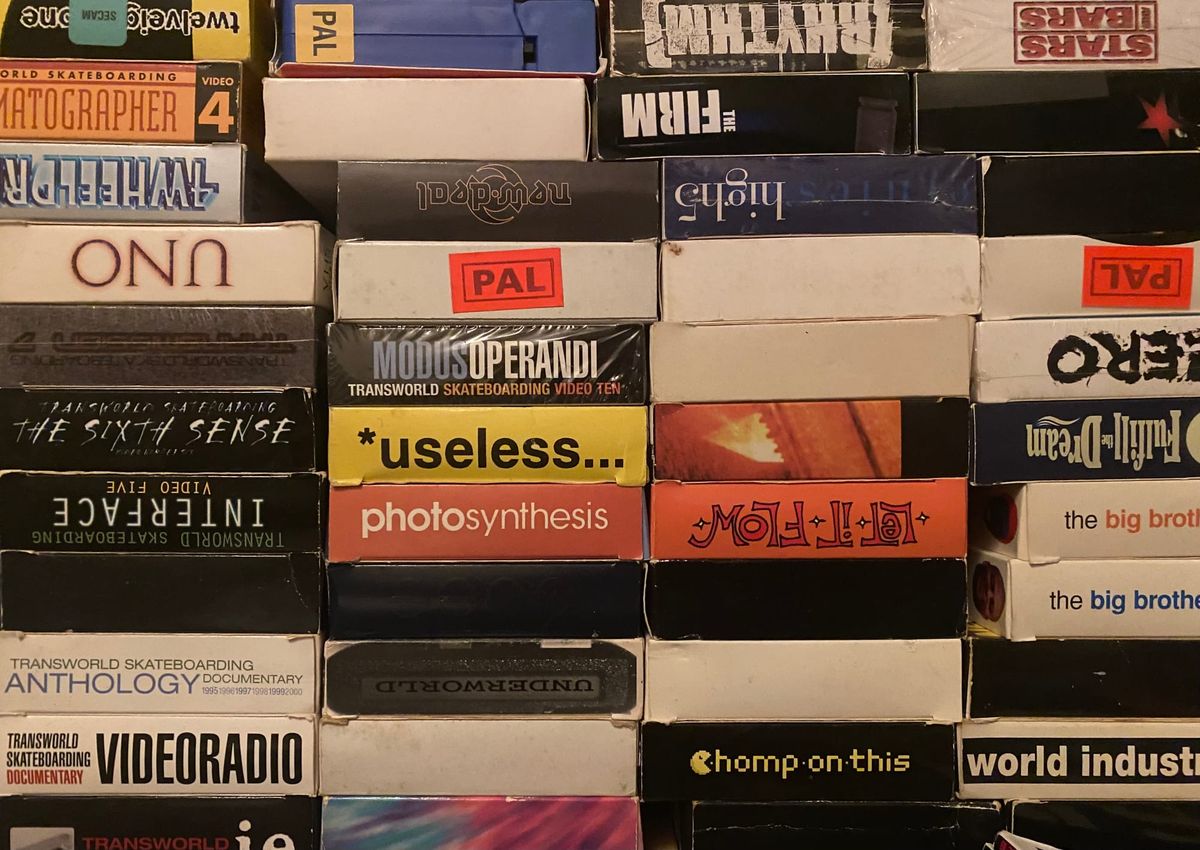
The longer-lasting counterbalance, though, was the series of videos produced by TWS (1996 - 2018), with production values that could rival the best brand videos, yet conceptualized and themed as one would for a high-quality print production. TWS Videos allowed young filmmakers to prove their motivation and worth and gave them the opportunity to just do that: Dan Wolfe, RB Umali, Jon Holland, Chris Ray, Mike Manzoori, Russell Houghten, Torsten Frank, William Strobeck, Chris Middlebrook, Ryan Ewing (“Beagle”), Brennan Conroy, Greg Hunt, Jason Hernandez, Ewan Bowman, Skin Phillips, Ty Evans, and Ted Newsome. Notably, many of these young directors continued to develop their skills, style, and voice, filming, editing, and directing for brands during the second part of the decade.
Two years before TWS’s video venture, Spike Jonze/Girl released Goldfish. The intro comes from the Sabotage video he made with the Beastie Boys. What’s interesting about Spike Jonze’s productions is that they feel like he took Powell-Peralta’s skit notebook, read the underlined Hollywood inspirations, and built a cinematic narrative on top of the documentation, using sequences and tonal shifts. Not only did he enhance the emotional arcs since Video Days, but Yeah Right! and Fully Flared also introduced visual effects (green screens and boards, pyrotechnic intros) that played like cinematic expression. In doing so, he elevates the skate video genre into an authored filmic world, as he kept importing techniques from music videos and commercials—precise song-image sync, bold camera movement, graphic composition, and skits performed by well-known actors—all while keeping the insider authenticity. The videos became a commentary on the unreality and mythology of skate footage.
A panoramic view of the rest of the production is no less rich. Welcome to Hell (1996) by Jamie Thomas is a continuation of Ternasky and Rosenberg's experiment. FTC — Penal Code 100A (1996) by Aaron Meza was a shop video with absurd historical density. In Underachievers (1996), Dan Wolfe brought up the East Coast sensibility as an essential counterweight to California-centric videos. Zoo York's Mixtape (1997) by RB Umali proved itself a cultural document of NYC skateboarding's cross-pollination with downtown/hip-hop culture, graffiti, and street grammar. In a July 1999 New Yorker profile on Tony Hawk titled “The Birdman,” writer Mark Levine explicitly says of Misled Youth that it is “a masterpiece of the genre, a film with handmade production values which moves through thirty-five minutes of aggressive skating at warp speed yet seems to luxuriate in the ugliness of concrete and steel. To see these guys streaking down handrails and over stairwells—and, in one instance, across the hood of a car—is to see skaters in search of something that is beyond their capacity to understand. If the young Jean-Luc Godard had made a skate video, ‘Misled Youth’ would have been it.”
VI. Maximum cinéma vs maximum collage
Building on the list from the previous chapter, you can add another couple of dozen, all contributing to the dominant model of full-length VHS/DVD by a brand, expanding to unprecedented proportions: Photosynthesis and the DC Video by Greg Hunt; Sorry by Fred Mortagne; This Is Skateboarding and Stay Gold by Jon Minor and Mike Manzoori; and Dying to Live, Sight Unseen, In Bloom, Good & Evil, That’s Life, and Baker 3, which told the story of a generation. At that point, it seems almost everything prior was an ongoing experiment, during which the cameras, programs (apps), and gear took time to improve.
Ty Evans has been clear in conversations that his two central influences were the Powell productions for brand-world mythmaking and Ternasky/Rosenberg’s work for architecture: tricks serve a very conscious emotional arc. Across the Yeah Right! (2003)/Fully Flared (2007)/Pretty Sweet (2012) arc, over a 9-year span, Evans pushed the cinematic ceiling of a skateboard video higher than it had been before (and so far), with all the attendant costs and benefits: long tracking shots, phantom cams, color grading, sound design, etc. The question of whether a skate video was a video or a film stopped being interesting to argue about because they were obviously indistinguishable. Ty’s productions were art pieces made to last, even after they had been technically ‘outdone.’
Right about that time, Dogtown and Z-Boys came out and was shown at the Sundance Film Festival on January 19th, 2001, with a theatrical release in April 2002. At Sundance, Dogtown and Z-Boys won both the Documentary Audience Award and the Directing Award (shared). Then came Lords of Dogtown, directed by Catherine Hardwicke, in June 2005. Lords of Dogtown, on the other hand, treats the Zephyr story as a string of iconic moments rather than building a tight central arc with clear cause‑and‑effect. It leans on archetypes and performances and overextends into too many thematic lanes, so most of them end up feeling thin. Not the “Big Wednesday” skateboarding was hoping for. The Bones Brigade Documentary, which came out in 2012, was a colossal success across the industry.
While many brands’ full-length films were peaking, a parallel economy of productions by crews, homies, small teams, and shop videos was multiplying across cities. Small-budget, high-influence tapes, gritty in essence and with minimal frills. They were snapshots of eras and places, putting spots and cities on the skatable map. That’s how Barcelona and Shenzhen became destinations. The VX1000 became the de facto tool for skate filming. It had a recognizable aesthetic: 4:3, on-board fisheye, handheld, and a certain type of audio glitch. This “gritty” tradition keeps the cinematic side honest. The side effect? A two-bracket way of understanding skateboarding.
The internet eventually added another bracket. What began as a difference in production methods became a transformation in the culture’s relationship to consumption. The web part shortened it again. That interval wasn’t empty. It was where the full length still acquired order, rhythm, proportion, context, and consequence. It was also where the collective consciousness (aka the endless conversations) had time to decide whether an occurrence was a meaningful addition or a passing gesture. Alas, the interval was doomed to contract; the reflection to become blurrier. Sure, you had “on-the-ground” pulse-checking à la Thrasher Magazine or The Berrics. But if they disappeared, would you remember a video posted there? Do you remember any video posted on The Berrics? Just askin’.
VII. Hollywood Borrows the Board
While the culture was building its own language, Hollywood kept renting the vocabulary. In 1985, the most-watched piece of skateboarding footage on the planet was Marty McFly's chase scene in Back to the Future — Per Welinder and Bob Schmelzer doubling for Michael J. Fox — and it moved more boards than any brand video ever would. Thrashin' (1986) gave skateboarding another love story in the shape and form of West Side Story, with Josh Brolin flanked by Alva, Hosoi, and half the industry playing themselves as gang extras. Even Police Academy 4 (1987) smuggled in a full skate sequence, with Bones Brigade riders doing the actual work under the slapstick. Gleaming the Cube (1989) completed the cycle: Christian Slater as a skater-detective, Mullen and McGill under his haircut, and Tony Hawk delivering pizza in a speaking role. The core rolled its eyes at all of it — the plots were absurd, the “skate rats” were costumes — and yet these films were, for millions of kids, the first point of contact. Hollywood couldn't speak the language, but it broadcast it. The eye-roll and the recruitment drive were the same gesture.
Kids (1995) inverted the arrangement. Larry Clark pointed his outsider's camera at the actual Washington Square scene — Harold Hunter, Justin Pierce, a script by a nineteen-year-old skater named Harmony Korine — and the result was so raw that America mistook a portrait for an exposé. The culture that had been played by actors was now playing itself, though still for someone else's lens and someone else's moral panic. It took two more decades for the authorship to flip completely. Mid90s (2018) is Jonah Hill directing, but it is cast with real skaters, shot in 4:3, and paced like a video part with dialogue — a film that could only be made by someone who had absorbed thirty years of skate videos as a native speaker. And Minding the Gap (2018), the finest of them all, closes the loop entirely: Bing Liu began as a kid filming his friends — sponsor-me footage, essentially — and ended with an Oscar nomination, having discovered that twelve years of skate clips were secretly a document about masculinity, violence, and escape. The skate video didn't imitate cinema; it became cinema's source material. The trajectory is the point. Culture as costume, then culture as cast, then culture as author.
VIII. The Part Leaves the Whole
From the beginning, the “part” has been the fundamental unit within the full-length video. One of the biggest breaks in skate videos was the part’s gradual detachment from the team video, allowing it to circulate on its own and carry the promotional and cultural weight of an entire project, centered on the singularity of a skater’s movement, environment, and presence.
Rodney Mullen vs. Daewon Song, Round 1, released in 1997, may be one of the first major conceptual departures from the conventional team-video structure. PJ Ladd’s Wonderful, Horrible, Life in 2002 still included other skaters, notably Alexis Sablone, yet it circulated culturally as a PJ Ladd event: one personality and one performance overwhelming the nominal container. Josh Kalis’s section in Alien Workshop’s Kalis in Mono (subtitled “A Film Fragment”), filmed and edited by Greg Hunt in 2006, was the first to focus on the form. Dylan Rieder’s Gravis part, directed by Greg Hunt and released in 2010, was not the first solo release, but it may be the moment when the standalone part became a premium cinematic object: one skater presented with the aura and visual control previously reserved for a full video. Two years later, Colin Kennedy’s Quik part followed Austyn Gillette from a moving vehicle, constructing the film around the continuity of one body, one line, and one image.
What used to acquire meaning through adjacency, once detached, had to be manufactured in a similar context within a limited amount of time and with condensed intensity. In doing so, it gained a little self-consciousness and a better “digestibility.” Mark Suciu pushed the sophistication to an intense internal grammar. Tricks rhyme across locations. Lines answer previous lines. Architectural forms recur. One gesture sets up another several minutes later. The edit behaves almost like prose: establishing motifs, withholding resolution, and asking the viewer to retain visual information long enough to recognize its return. It presumes a hyper-literate skate audience. Half a century after Skater Dater, Suciu wrote an idiom entirely his own.
The single-part era arrived amid a surreal economic environment. One might think the market has grown exponentially since the mid-80s, when the top pros were making 10+k per month in board royalties. At that peak, a professional skater was part of a collective marketing proposition. Fast-forward 40 years, and the 200+ brands are all hoping to carve out a survivable slice of the market. The commercial script has completely shifted. On social media platforms, the skater’s name, image, following, and measurable engagement are not necessarily tied to the company that carries the model. In that case, their popularity is in the foreground; the brands become temporary coordinates surrounding them. When the question used to be: What does this team, company, or scene mean? The new question has become: Who is this guy? Skate parts increasingly build profiles. The segue to the consequential editorial position has people claiming to be “just filming with friends.” What deserves sustained attention, what constitutes progression, which mannerisms promote the skater, and which ones promote the company signing the checks?
Not every skater from every company gets to make a single part for a slew of different reasons. Note the ones who do and the ones who don’t. And compare this phenomenon with how board companies used to feature their whole team and what it would do promotion-wise.
IX. The Culture Eats the Interval
“Now a kid with a smartphone in their pocket can film their friends, edit the footage on the phone, and post it to social media immediately afterward,” said Craig R. Stecyk III at the International Skateboard Film Festival in Los Angeles in 2011.
It’s undeniably progress. Who doesn’t like seeing Daewon Song’s regular clips on Instagram? The caveat, there’s always one, is that the once “digestive” process used to constitute the very definition of culture. It is what we consistently do, make, and respond to—the repeated behavior that creates or adopts artifacts and aesthetics. What we wear, listen to, celebrate, and ignore, along with the unspoken rules, are the consequences of culture. And, ultimately, culture morphs into identity. Skate movies synthesized this, giving form to a moment in time and influencing what comes next. Viewers anticipated the video’s arrival (with magazine ads to build hype). Skateboarders’ heartbeats accelerated to 411 Video Magazine’s cadence.
But the wait was never doing this alone. While the footage traveled—weeks by mail, months between magazine drops—it was also building the thing that made the footage legible: an audience arriving at each video already primed to read it the same way everyone else did. The interval produced two things at once, the work and a synchronized viewership. We only ever talk about the first.
Now, algorithm-driven social media consumes that latency. Not only can the trick (or content) be made public before the session ends, but neither the sender nor the recipients have control over this “message in a bottle”. The filmer, skater, and brand control only the image’s entry point and the necessity of its existence. The rest is another level of control. In its advertising pitch, the newly created The Den, a conglomerate platform, states: “Skateboarding has always been shaped by the videos that represented it. It’s how a lot of us connected to skating in the first place. Lately, videos are treated as disposable content. The algorithm decides what gets seen, and full-length videos are reduced to a couple of clips in the feed. That’s not how skate videos are meant to be experienced.”
By now, aided by the culture of doomscrolling, we all experience the new truth: watching a full one-hour brand video feels tedious, even if you like the brand, the team, or the context. It’s not the filmmakers’ fault. It’s a sign of the times. Social media dissolved the conditions that had made a shared skateboard-video culture possible and enjoyable.
The issue is widespread. In his article in The Atlantic, “How Lizzo Became One of Pop Culture’s Great Flops”, Spencer Kornhaber wrote that the singer flooded the internet with posts blaming her label, the algorithms, and the decline of radio for an album that sold just 2,650 copies in its first week and missed the Billboard 200 entirely. His larger point is the one that travels: “The real nightmare—for her and so many others who are anxious about flopping right now—is not that she’s being blocked from the market, but rather that the market is all there is.”
This acceleration is often described as abundance. It's generally understood that the more skateboarders are visible, the more scenes can represent themselves, and that most forms of exclusion are slowly weakening. Abundance has another consequence: skateboarding has less time to metabolize its output. And when the images reach a whole new category of practitioners (or their parents) with very little background or literacy (and a limited desire to learn all the intricacies), and with only one aim, straight for any form of ROI, aka their goal, what appears on their screens without acquiring sufficient weight doesn’t add to the definition of culture.
Everything seems worth posting if it produces dopamine. The newly appointed “historian” elbows the “teachers,” the pros, and the influencer. A new post doesn’t take time to evaluate its own existence; it immediately becomes old with the push of a thumb. It piles onto already-existing samples, taken out of context. It revives them and converts them into instantly recognizable material. How many different copies of 70s surf-style skateboarding can you watch before you've had enough of it, already? How many ways to learn an Ollie or a flip?
We already met that sealing — the Bones Brigade Video Show strange to a newcomer, the vert era half-foreign to the street kids — and shrugged it off as the ordinary friction between generations. It wasn’t friction. It was the mechanism. The opacity kept each layer apart long enough to cohere before the next one could see it, and that separation, not the footage itself, is what turned self-documentation into culture. Call it what it was: membranes. Thick enough that an era had to become itself in private. The archive dissolved them. When sixty years of footage is equally available and equally weightless in the same feed, the layers stop being sealed and start bleeding into each other. We didn’t just lose the wait. We lost the walls the wait was quietly building the whole time.
And if you were wondering about the rest of the industry: “As time goes on, we have a shorter amount of time to film. Back in the day, you had a couple of years [ahead of you]. I put that year out [filming 5 parts for his SOTY year], and now everybody’s like, “Oh yeah, five parts in a year.” Now everybody wants to film five parts in a year. But nobody says, “I want to make something that actually means something. Let me put some time into it because […] it’s also what the industry wants and needs.” But it’s kinda hard to do that with the amount of time expected of you in this day and age, given where skating currently is,” said Ishod Wair in an interview with the Bunt (season 23, episode 12 that aired on April 15th 2026).
X. The Test of Time
If the walls between the layers are gone, endurance stops being something time hands you and becomes something you have to build by hand. That is the whole story of what’s left. The ripple effect? Productions à la Evans, Hunt, Jonze, or Peralta have almost disappeared due to a lack of fuel and oxygen. What an irony for an Olympic “sport”. In the couple of hundred productions for 2026 so far, only a few run over 30 minutes, with William Strobeck’s “Squeaky” for Violet easily topping at 54 minutes and the Thrasher/Spitfire “San Francisco Burning” at 33 minutes. The rest? A lot of minutes-long social media clips.
Speaking of his “Squeaky,” which leans on intentional observation, William Strobeck’s work, including accidents and aftershocks, operates on an emotional level. Cherry was a forceful editorial reset, while later work drifted toward observational seriality; same director, different coordinates over time.
Some other crews, like GX1000, still chase that aesthetic and pace as part of the VX1000 stylistic revival. Because the camera’s original aesthetic is inseparable from its material function, it invites a particular attitude. Just check the end of “Spring 2026” for an actionable hint.
Skateboarding has always built on the remnants of its own history. Like a tree finding new ways to grow after meeting an obstacle. Most culture does that. But if this “Cultural Cannibalism” is increasingly feeding on its own already-digested content because the circulation system rewards recognition faster than experience, it won’t necessarily generate new meaning. Old logos, camera formats, clothing silhouettes, trick selections, music cues, spot types, graphics, and attitudes return not necessarily as historical arguments but as readily consumable signals. The past becomes a resource library for the continuous production of the present. Paying homage is great. Regurgitating for the sake of feeding an always hungry beast is a whole different scenario.
Cannibalism is what porosity looks like when nobody fights it: every layer within reach, all of it recyclable, none of it separated long enough to mean anything new. Which is exactly why the people who still make work that lasts are the ones deliberately rebuilding the wall the archive tore down.
Thomas Campbell embodies that refusal most completely. A painter and photographer of the Beautiful Losers generation, he began by shooting skating (Debunker for Santa Monica Airlines in 1991) before turning his lens to surfing. He built the surf trilogy — The Seedling (1999), Sprout (2004), The Present (2009)— on 16mm, with patience and a craftsman's indifference to deadlines, then brought the same discipline back to skateboarding with Cuatro Sueños Pequeños (2013) and Ye Olde Destruction (2019): years in the making, shot on film, edited like an object meant to outlast its release date. Campbell closes a loop the genre opened with Bruce Brown: the surf-film recipe skateboarding borrowed in 1976 returns, as a deliberate act of resistance. In an economy of instant circulation, his method is the argument — some images are worth waiting for.
And he isn’t alone. Creativity is still here, as the selection for the Milan Skate & Surf Film Festival clearly shows. Movies like “Skater's View, Why are skateboarders still riding on the street?” by director Shota Inagaki; “COLORS”, a short documentary by Davide Caforio & Michele Pantuso; “Mongolia, Children of the Sky”; “Beauty”, a film about the beauty of being different by Eduardo Muñoz & José del Corral or “UNSUNG” Beyond the Board by Thomas Liddell, demonstrate the incredible resilience and vitality of movies made with skateboarding as an engine for social change.
For decades, skateboard films were the central way skateboarding learned to see itself and, consequently, to construct itself. They were considered the pinnacle of skateboard communication. Both a record and a design system… with a lot of trial and error along the way.
Today, the trick vocabulary is mature. There are still innovations—new ways of linking tricks, new terrain, different body mechanics—but they are, for the most part, refinements. It’s a strange dichotomy, given the public's lack of knowledge about it. The Powell-Peralta videos, the Ternasky/Rosenberg, Greg Hunt’s, and Ty Evans’ would set the scene, each proposing a different reading of skateboarding aligned with the brand’s image development.
Today, filmmakers have already absorbed sixty years of visual language. When Spike Jonze did “the Parallel,” there was a mood for it. Now the “Parallel” offered is the one between Daewon Song and Mark Suciu for Adidas. The grammar has become standardized, and the narrative frame has loosened. When Citizen Kane introduced deep focus and unconventional editing, audiences were astonished. Today, we don’t emphasize them because they have become part of the cinematic language, which has become invisible through its success. Now it’s all microscopic adjustments, speaking as loudly as the difference between Public Domain and Speed Freaks. That’s the definition of a mature language.
Are we riding into the sunset on banalized storyboards? No, au contraire, mon frère! Indeed, the expectation is much harder to satisfy, yet someone somewhere is already mastering the new tools to present skateboarding in the most purist fashion.
Because, you see, there has been no Golden Era of skateboarding film. Just as there is none in skateboarding. Just layers. Each decade adds to the evolution of language. There were successive conditions of possibility. Each technology enabled a new kind of proximity, construction, circulation, or authorship. Films introduced rarity. Home video created inhabitable worlds. Smaller cameras brought immediacy. Linear editing gave the medium its grammar. Video magazines established periodicity and global exchange. DVDs enabled scale and cinematic ambition. The web opened access. Social platforms compressed everything into simultaneity.
On October 20th, 2024, during a conversation with Templeton Elliott and Jason from Frozen in Carbonite for Mostly Skateboarding, Josh Stewart from Static explains, “I won't name a project, but a huge shoe video comes out. And it's a topic of conversation for two or three days. And then there are four clips from it on a Quartersnacks top 10. And then the next week, it's on to the next one [video topic]. I think brands just realized nothing has that staying power it used to [have].”
Stewart and Campbell aren’t contradicting each other; they’re describing the two ends of the same broken mechanism. Stewart is right that nothing sticks anymore — not because the work is worse, but because it’s replaced too fast to imprint anything on the collective mind. And Campbell is right that some images still last — precisely because he rebuilds, by hand, the separation that would once have come for free. What doesn’t stick fails not on quality but on tempo. What lasts, now, is whatever manufactures its own interval.
“Nothing has that staying power it used to have”… It's interesting to watch the distance that once turned self-documentation into culture now dilute it into ephemeral content. A first thought is that skateboarding risks becoming exceptionally skilled at reproducing the language of what it was but isn’t anymore. It’s a form of regression ignoring itself.
The irony is that the first filmmakers had no idea they would lay the groundwork for what made skateboarding so appealing, nor could two generations of directors have predicted that the language they refined would eventually become available to everyone, everywhere, at every moment. That is both the genre's triumph and its present crisis. Skateboard films began by placing a narrative over footage of a few children skating through Southern California. Sixty years later, everybody can place a narrative on skateboarding. The unresolved question is whether anyone will still have enough time to discover what that narrative truly means and what it will ultimately produce, beyond simply trying to grab a piece of the cake.
Thank you for reading.