![Carte Blanche [Skateboarding]](https://storage.ghost.io/c/e8/66/e866238d-c304-4142-8930-e488e4890869/content/images/2026/08/Carte-Blanche---Skateboar-4.png)
All In with Dave Swift
I. THE BOOK
I really love your book. I think it's very original in the way you made it. Tell me about the process. Were you sitting on thousands and thousands of photographs and suddenly thought, Okay, I need to make a book now?
DAVE SWIFT: I'd been thinking about it for a few years. Then Pete Thompson did his book, and that made me think, Man, I really want to do this. I wasn't doing much. Occasionally I'd have a photo shoot, but rarely. So it became: let's do this.The other thing was that I wasn't going to pay for it myself. Grant had told me, "You should do a book, but don't pay for it yourself." Finding a publisher, somebody who would actually pay for it, was probably the hardest thing. That's where Pete came in. He'd found a publisher for his book. I asked him some questions, and he helped line things up so they (Goff Publications) would talk to me.
I already had everything pretty well organized — files on my phone and computer with my favorite photographs. We're talking about thirty years of photos, so they were big files. Then I started editing: I won't use this one, I'll use this one; this is repetitive; I don't want too many Back Smiths, whatever it was. I was constantly refining it. Once I had the publisher, it became: Okay, now I have to make a book. How do I want to organize it? I wanted to tell my life story without actually telling it. Because my life story is skateboarding. And I didn't want to show a bunch of photographs of me skateboarding.
There's something very specific about the organization of the book. I wondered whether it was conscious.
DAVE: Definitely. There was more than one organizational technique, but I wanted it to flow like a magazine.
There you go.
DAVE: Because I worked in magazines for so long. That's how I viewed skateboarding. A lot of people view skateboarding through videos. Their memories are, I remember this from that video. I remember everything through magazines, all the way back to the late seventies. I can remember skateboard photographs and what was on the cover of a magazine. It's ridiculous that I can still do that. And after making magazines for almost thirty years, it's ingrained in me. It flows like a magazine.
That's exactly what it feels like to me. It's a big, thick magazine with a hardcover. And it's also in the choices you make. Frank Hirata is a good example. He's known, obviously, but he's not the obvious person you'd put into a book because you think his name is going to sell copies. He's deeper in the core of skateboarding.
DAVE: He's an underdog. To me, he was one of the best street skaters of the time. I would say he peaked early. His talent came along a little early, monetarily speaking. By the time skateboarding got popular again, he had already moved beyond being progressive and was moving on to other things. The book is also chronological in a way. That's why it starts with Cab. Steve Caballero was the first person I ever photographed, almost eight years before I worked for a magazine. I photographed him at the Palmdale Desert Ramp contest and saved that photograph.
Cab wasn't necessarily a huge part of my story in terms of knowing him when I first started working at magazines, but over the years we shot a lot together. Then he was the first person I photographed who made it into Transworld, in 1989. We were skating at the San Jose warehouse. I photographed him, Mike Youssefpour, and I think Jason Jessee was there. The photograph that ran was Steve. So it all lines up: first skateboarder I photographed, first photograph of mine in the magazine, and I'm still shooting him today. He spans my whole life in skateboarding.
The other people I did little features on played a big role in my growth as a photographer. Through their skating and through being able to photograph them, whether they were at their highest level or were older men and women who still skateboarded, they've been part of my life and my growth as a skate photographer. I didn't want to write about myself because I'm not a big look-at-me guy. That's why there are quotes from all these different people. Getting those quotes was probably the hardest part. They'd say yes immediately. Actually getting the quote was another thing.
I'm experiencing that right now.
DAVE: Danny Way and Christian [Hosoi] took forever. The funny thing is, once I finally got them on the phone or met with them, they talked the most. I have way more material from them than I put into the book. It became like doing a magazine interview again.
II. WHY THE 1990s MATTERED
Somewhere you say that the nineties were some of the best years in skateboarding. When I first read that, I thought, I'm not sure about that. Then I went through the book and thought: actually, yes. The nineties were probably one of the most interesting decades in skateboarding.
DAVE: So many different things happened in such a short period. When I started working at Transworld in January 1989, street skating existed, but it hadn't taken over yet. The industry was still dominated by the old giants from earlier in the decade: Powell Peralta, NHS, Santa Cruz, Vision. It wasn't really run by skateboarders. Skateboarders were mostly the faces of those brands. During the nineties, that changed. You had skateboard companies owned by people like Tony Hawk, Lance Mountain, Rick Howard. You had Pierre André, Sole Technology, Etnies. Skateboarders took over and made the industry their own.
And that helped skateboarders immensely. Even if you weren't the best skateboarder in the world, there was somewhere for you to work in skateboarding. Everywhere you went for skateboarding, you met other skateboarders who loved it as much as you did. I thought it was a fabulous time. And then there was the progression. In the beginning of the decade, vert got pushed aside somewhat, but not because somebody deliberately decided to kill it. Street skating became overwhelmingly popular worldwide. The progression was immense. It felt endless for at least the first five years of that decade. Then things settled somewhat. Everybody found their piece of it, terrains changed, and skateboarding adapted.
III. WHAT HAPPENED TO SKATE MEDIA?
Let's switch to magazines, since you have a little experience with those.
DAVE: A little bit.
Where are we now? Not only magazines, but media and publications — the things that generate a culture around skateboarding.
DAVE: Without sounding like the old guy complaining, everything is so commercial now. Things aren't necessarily done purely because somebody says, There's this dude in Wichita, Kansas, who rips on a skateboard and has a really interesting story. Let's do it. If there isn't some financial gain for somebody, it's much harder for that story to get into a magazine.
I'm not saying every publication works that way, but with the most popular skate publications, so much of what appears is connected to somebody paying for something. This company advertises. This company gives us money for the website. This company sends us on a trip, so we have to run everything from that trip. You can have an incredible skateboarder with a great story, but if he doesn't have the right sponsors financing the magazine, he might not get in. We've lost something there.
We used to go on trips with skateboarders from all sorts of teams. We'd find spots, document what happened, and put it in the magazine, hoping advertisers would advertise because they wanted to be in it. It wasn't necessarily, We have an article on your team, so now you pay us.
That started changing in the early 2000s. You could still find little gems in magazines that weren't working that way, but slowly, everybody had to buy into that system just to survive in print. And I think that's one of the things that eventually hurt magazines. They became less interesting.
Do you still read skate magazines?
DAVE: Kind of. Well — no. I stopped probably a year ago. Without naming names, I would get a magazine and think, It's the same shit every month. The same people. Where are all these other people who are skateboarding? It was always the same few brands. I want to see different stuff. But I'm old. I'm not a kid, so I can't necessarily speak for what kids want now.
IV. "OUR JOB WAS TO KNOW"
Do kids necessarily know what they want to see? Or are they being fed what's available through media and social media?
DAVE: When I worked at magazines in the nineties, we didn't do research. We were skateboarders. Our goal was to showcase skateboarding to skateboarders. First and foremost, it had to be legitimate to people who actually skated. We had an idea of what they wanted to see, who they wanted to see, and what was happening because that was our job — to know. And we had to be a little ahead of the curve.
You've pinpointed something that's at the heart of making a magazine. If you have to figure out what kids want to see, you're probably already out of the loop. If instead you're showing something you genuinely love and are part of, then you're inside it. An old friend of mine who used to make magazines once told me: If you have to think about "the kids" while you're making a magazine, you're already lost.
DAVE: That's how I looked at it, even as I got older. My goal wasn't for me to keep writing or putting things into magazines simply because I liked them. Eventually I was outside the loop. I still rode my skateboard. I was around skateboarding. I knew what looked good as a photograph. But I couldn't necessarily speak for what the newer progressive generation was doing. If I'm on a trip with a bunch of seventeen- and eighteen-year-olds and I'm forty-two, their style and everything around them might not be what I'm about.
Their skating could be great. I could document it. But writing about it could feel weird, like I was pretending to be this young, with-it skateboarder. I didn't have anything to prove. I'm a skateboarder. But I would rather read what somebody from their age and their generation had to say about it.
V. WHO GETS TO DOCUMENT A GENERATION?
Does that mean skateboarding is purely generational? That you can't write about it if you're not from the right generation?
DAVE: You can. But sometimes it seems weird. Dave Carnie is a great writer. He can write about skateboarding. But put him on a trip with a bunch of kids, and it might be funny because Dave is funny, but it won't necessarily tell you what that generation is about. I'd rather see a new Dave Carnie. A new Kevin Wilkins. Writers who are out there and clued into what the current generation is doing and wants to read. Same thing with videos. Old dudes directing younger skateboarders can feel weird to me. I'd like to see younger directors, younger artists pushing skateboarding culture forward. Anybody can go to a contest and cover a contest. It's all the same: so-and-so did these tricks, got this score, and took first place. Boring.
If you're going to write something really in-depth about skateboarding, I think you have to be connected to the generation you're writing about.
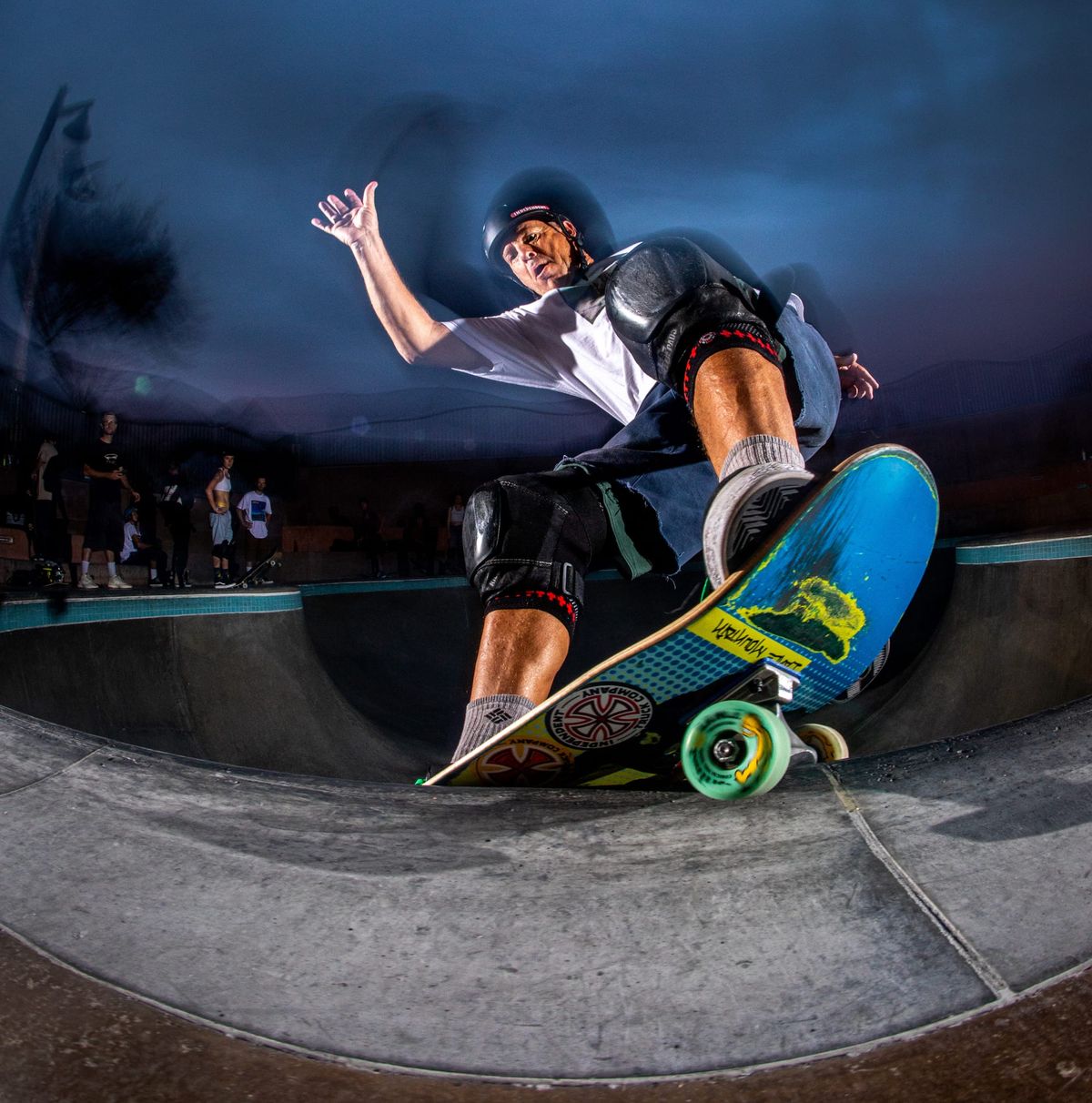
I can still write about the generations I was deeply involved in — the eighties, the nineties, maybe the early 2000s. Beyond that, it gets harder. The last thing I can think of that I was really deep in was backyard pool skating, from around 2012 to 2019. Ben Raybourn, Kevin Kowalski, those guys. I spent time with them. I was in the vans. And the skateboarding felt familiar. There was something throwback about it. They felt closer to the eighties or early nineties to me than they did to modern skateboarding.
But here's the other side of that. How do you talk about skateboarding if you have very little exposure to its earlier part of the story?
You can understand a new period of pool skating partly because you know the first periods of pool skating. If you've never been exposed to that history, you can look at something recurring and describe it as new when it isn't new at all.
That's the part I find interesting.