![Carte Blanche [Skateboarding]](https://storage.ghost.io/c/e8/66/e866238d-c304-4142-8930-e488e4890869/content/images/2026/08/Carte-Blanche---Skateboar-4.png)
Skateboarding didn't lose its soul — it lost its editors
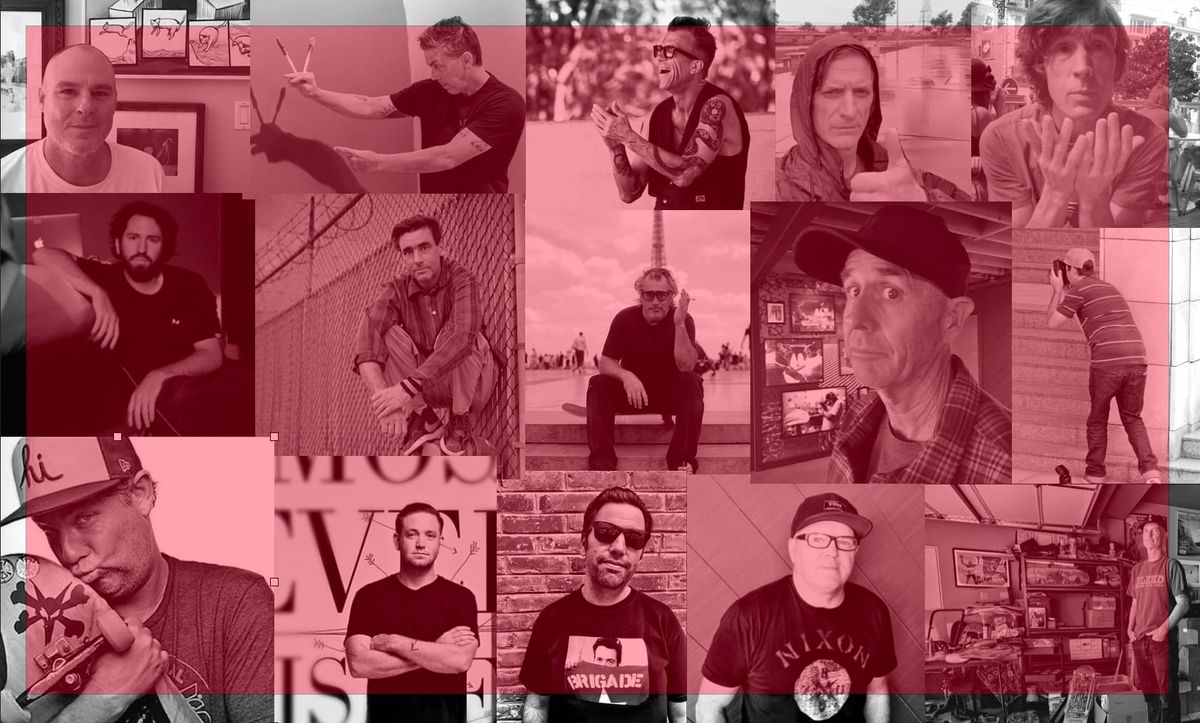
Skateboarding has gained “respectability” over the past years. But what has been left in the scales might be far more valuable and irreplaceable. The once-close-knit community now faces a world where meaning and originality are ignored.
I. Scene: Visibility ≠ Health
At a skatepark, different stories unfold.
A young guy struggles with his mismatched board—narrow trucks and wheels, bushings cracked from tightening too hard, front wheels crying for mercy. He tries two tricks repeatedly, less determined than starting math homework on a Sunday evening. If he lands one, it will be mostly a matter of luck. He stops, sits, and scrolls his phone, searching for a distraction. Will a dopamine hit match the missing adrenaline? Questionable.
Nearby, a mother films her daughter as she nudges her forward, elbowing her way into the mini-bowl rotation. A useless display of passive-aggressiveness, as the older crew of four was already making space to include her in the next run. There are almost imperceptible yet very accurate details revealing the vibe of a truly motivated one; they already recognize it in the girl’s gait.
At the deepest part of the park, a loud group feels like they have earned their way to the top of the food chain. They know the dude who’s bro with the dude. Proof in hand.
Finally, under the filming scrutiny of a couple of helicopter parents with an agitated toddler around, hopping from section to section of the skatepark, a “skate teacher” won’t let go of the young boy's hand for fear of him crashing on the ground like a lost egg.
A full 180-degree sweep of the scene is enough to acknowledge the dissonances. The lonely kid needs advice; the mother sent a passive-aggressive vibe on the older group's semi-private session of inside jokes and mentorship; the confident newcomers lack the stories to match their swagger; and the teaching session took away the feeling of freedom. The essence of it all.
II. The (false) diagnosis everyone agrees on [Or The Editorial Function (What Was Actually Lost)]
Do you feel it, this disturbing sensation that something has shifted? What once was a self-orchestrated symphony with an inner sense of direction has eroded as the thin but essential grease has been washed away.
Isolated, none of these moments would have been dramatic. But taken together, they reveal something deeper. The contextual pressure of aggressive capitalism, the explosion of hardgood brands (who have accelerated the process of over-homogenization, a convergence not due to a creative failure, but a structural outcome), the promotion of bigger contests as ultimate pre-Olympics warm-ups, and a new generation (and their parents) less interested in respecting history than in cashing in on the future. In the shadow, the ultimate puppeteer, the sacrosanct social media, armed with a battery of algorithms, metrics, and virality, adds layer upon layer of noise into a cacophony.
The only voice capable of dimming that cacophony was the “Editors’.” The editorial function—once embodied by journalists, photographers, filmmakers, veteran skaters, company founders, shop owners, and other trusted figures—meant more than just passing along information. Editors contextualized, filtered, and preserved the meaning of skateboarding, ensuring that its soul and unique qualities survived and were communicated across generations. Now, this role has mutated with the algorithm.
They were the open source of creativity and context for newcomers and veterans before industry integration.
III. Two Steps Take Over
Within its 60 years of life and growth, skateboarding gave birth to a new form of behavior: Editing. Sports had coaches, commentators, supporting staff, skateboarding, not considered a sport for the majority of its existence, had “Editors” who would contextualize, slow things down, handpick what matters and why (for instance, good style vs crappy one), and, most importantly, create continuity across time. They had no job titles (until they were given a job), they were not gatekeepers-as-police but mediators of meaning.
They are (or were) the creatives who were respected and listened to. They have (or had) their thumbs on skateboarding’s pulse. As the function started to disappear, legible arose. That’s incompatible with long-term growth.
Came June 2013. Instagram introduced 15-second video uploads with basic in-app editing. Then, the platform, mixing creativity and self-curation, became a feed driven by motion, performance, and attention rather than by presence, as the algorithmic ranking was introduced in 2016 and later became more complex.
If the timeline matches the end of many publications, don’t be surprised: Editors didn’t leave by choice—they were pushed out by clicks. Meaning lost to 'uneducated opinions.'
The second rupture, I bet you guessed it, is AI. There is nothing wrong with using a good tool. Only that this time, AI doesn’t just distribute culture, it pre-edits it… In a dangerous way, when used by people with little to no background in the culture. Now, prediction replaces judgment, probability replaces risk, and simulation replaces experience. AI doesn’t kill writing, images, or skateboarding. It kills generic competence.
Taste becomes scarce, refusal becomes permanent, accountability completely disappears, and time becomes obsolete.
Advertisers, brands, and readers now accept the digital platforms’ tempo. They’ve replaced editorial authority with short-lived metrics. The change runs deep.
The sometimes torturous self-censorship, “Is this meaningful?” has changed to a far less ethical “Does this move?” The internal barometer is set to another degree in “acceptable by the masses.” As if skateboarding had any care about pleasing the masses during the first few decades of its existence. Now it does. Scrolling replaces acuteness.
IV. What replaces editors as they vanish
Not long ago, a renowned skate photographer noted—off the record—that the new generation lacks qualities that once defined the craft: an eye for detail, risk-taking, embracing imperfection, a personal visual style, and the irreversibility present in earlier work.
The observation wasn’t nostalgic. It’s structural. Digital cameras and smartphones didn’t make photography easier; they shifted the difficulty towards something more insidious. Where it once lived before the shutter—where decisions were final and mistakes taught style—it now shows later. Errors are correctable. Aesthetic decisions migrate to post-production, which, for efficiency's sake, leads to a sense of sameness.
Talent is not necessarily eliminated. But the path toward competence is flattened, making originality harder to emerge organically. Not because younger photographers are lazy or less passionate, but because visual languages are now shared globally and in real time. Reference pools are wider and simultaneous. Styles converge before they have time to mature. Even talented photographers converge into a visual stream optimized for performance—this ungrateful muse. When everyone sees everything instantly, deviation becomes statistically rarer. Originality once required access. Now it requires resistance. That is a much higher bar.
This pattern extends to editors. In a world where technology minimizes difficulty, the editorial role becomes not just rare but vital. Editors were the ones who could sense new directions and nurture originality—protecting early styles and fragile concepts, allowing time for new approaches to evolve. They ensured distinctive voices and visions had a chance to mature, keeping skateboarding from blending into sameness.
Without that protection, cultural traits don’t disappear. They fail to stabilize long enough to become legible. Images and texts no longer assert a point of view strong enough to recalibrate taste. Worse, it is immediately challenged by the algorithm. Intellectual risk is smoothed out or even eliminated upstream. Selection favors consistency over rupture. Again: motion without accumulation. Loss of mediation and leverage under accelerated systemic sameness.
V. On the edge of consequence
When nothing is edited, when everything is a matter of productivity, nothing lasts. And when nothing lasts, scenes don’t immediately collapse— they thin out until they’re everywhere and nowhere at once. Like an overused trend. When the editorial layer disappears, a culture doesn’t die. It just becomes harder to recognize.
(This piece was originally publish on LinkedIn here: https://www.linkedin.com/pulse/skateboarding-didnt-lose-its-soul-lost-editors-fabrice-le-mao-xdfpc/ on March 24, 2026. I, then, said that it "This is a shortened version of a fuller piece that will appear in Carte Blanche [Skateboarding] on Substack in the coming weeks."
Two major events derailed these plan: Ghost and the "Skate Movies" piece.)